
Why Stratasys entered the Metal AM space with Tritone Technologies?

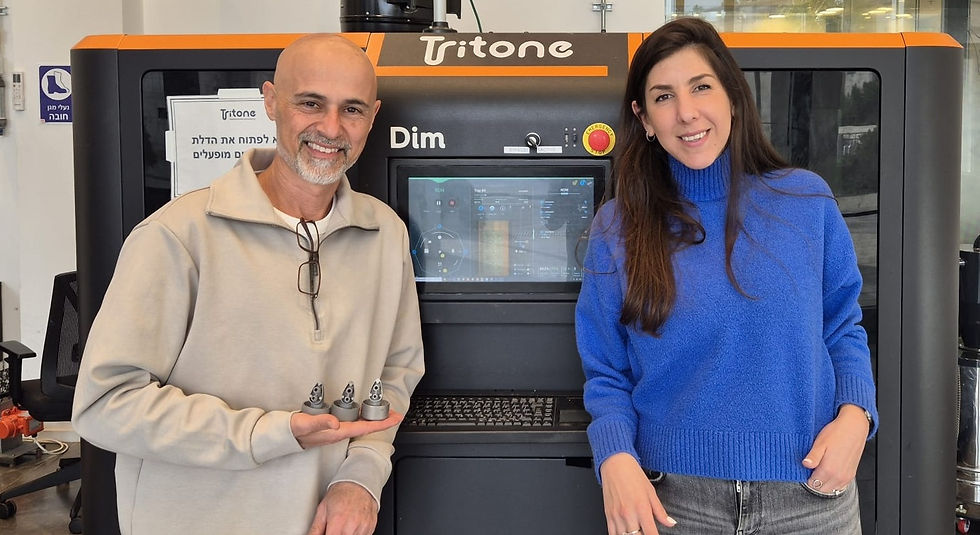
One of the most recent intriguing strategic alliances in the Additive Manufacturing Industry was announced last month when Stratasys, a global industry leader, and Tritone Technologies, a Metal AM startup, joined forces to focus on accelerating the adoption of Tritone’s Metal AM technology. The collaboration of these two Israeli-based companies seems like a natural move for both sides.
After holding back from metal for many years, why Stratasys chose Tritone’s technology as their preferred Metal AM solution for their customers base, and why Tritone found Stratasys as the ideal partner to promote the company’s products?
What makes Tritone’s Metal AM Technology Unique
Tritone’s Moldjet technology approach is fundamentally different from laser- or powder-based metal AM. Instead of sintering loose metal powder layer-by-layer with a laser or spreading powder and binding it, Tritone jets a thin printed “mold” and deposits a metal/ceramic paste (MIM-style feedstock) into that mold, then levels, debinds and sinters — in a powder-free, continuous, production-focused workflow.
This provides several key advantages over other metal AM technologies in the market such as SLM, DED, binder-jet and others:
A powder-free process - safer, simpler shop floor.
Hybrid MIM + jetting approach - good for production.
High throughput / continuous production design.
Lower post-processing complexity for many parts.
Multi-material / ceramic capability.
The practical meaning is that if you chose the right application, MoldJet technology can be more suitable for mass manufacturing then laser-based and binder-jet based technologies.
The Eyewear case study as a benchmark
One of the main key success factors in scaling Metal Additive Manufacturing to the production of end-use parts, is finding the right applications that suits a specific technology.
BAARS is a Paris-based eyewear brand celebrated for its minimalist design and magnetic
hinge technology. By combining functionality with refined aesthetics, BAARS creates
durable, high-quality frames that stand out in the premium eyewear market.
The luxury brand was looking for the right metal AM technology to produce high-precision hinges for thousands of eyeglasses. The main challenge was finding the best technology that is scalable for mass manufacturing, while ensuring both cost-efficiency and uncompromised design quality.
MIMPlus, an experiences user of Tritone’s technology, was able to face the challenge and leverage its capability to deliver high resolution and precision, ensuring hinge reliability and consistent dimensions, using Titanium TI-64. In addition, provide an outstanding surface quality that is critical for eyewear components.

The result, a scalable mass production process, capable of producing 16,000 parts for 4,000 glasses with 800 parts per tray. By using Moldjet technology, MIMPlus could successfully deliver thousands of parts, keeping accuracy, quality and repeatability at a similar level of alternative traditional manufacturing methods.

The synergy between Stratasys and Tritone
Until today, it was a well-known fact and a declared strategy of Stratasys to focus only on polymer technologies. Due to the increased adoption of metal AM technologies in recent years by manufacturers across different industries, Stratasys was looking to enter the metal space, but in the right timing and with the right technology that will fit the company’s DNA.
The global Metal AM space is led by two main forces – Western OEM’s such as Nikon SLM, 3D Systems, Colibrium (GE Additive), EOS, and Chinese OEMs such as BLT, HBD, Farsoon, EPlus3D, and others, that developed expertise in providing professional industrial metal AM systems in attractive price points. This enabled industrial users around the world to adopt and ingrate Metal AM in their manufacturing processes, in lower overall costs, and a competitive cost-per-part.

While looking for the right timing, Stratasys examined Tritone’s MoldJet technology and decided it’s a perfect match. The decision was supported by the following main key reasons:
Unique value proposition
Since most of the Metal AM space is dominated by laser-based systems, there was no sense for Stratasys to enter this solution segment as another vendor with a ‘more of the same’ solution.
Tritone’s Moldjet patented technology is unique in the landscape of the AM industry, offering Stratasys an advantage of adding to its portfolio a one-of-a-kind technology no one else has, similar to the company’s legacy Polyjet technology, without having to develop a new metal platform from scratch. The synergy between both sides opens up a unique opportunity to further develop and deliver industrial users a real metal mass production manufacturing technique.
Growth catalysator for the company and its channels
With the increasing demand from the market for an end-to-end industrial metal AM solution, Stratasys’ channel network was not able to peruse any business in the metal space. Many of them are also selling additional manufacturing solutions such as CNC, Injection molding systems, robotics, 3D software, finishing solutions, when Metal AM is a natural add on to their product portfolio.
Since Stratasys global channel network is one of the company’s greatest assets, adding Tritone’s advanced metal AM technology is a positive move. It will enable them to engage industrial users looking to adopt Metal AM, and increase their revenue in the coming years, and the company’s as well.
Supports the manifestation of the ‘market leader’ vision
One of the reasons the AM industry is facing growth challenges in recent years, is the fact it doesn’t have its own Tesla, Amazon or Apple. When looking at successful industries that constantly continues to innovate, you can often find one big company that pushes all the rest to keep up. The result is a healthy technology race that pushes medium and small companies to develop new and innovative products, pushing the boundaries to the next level.
In the AM industry, the market leader position is revolving over the years, when market share of the top companies remains more or less the same. Entering the metal AM market is an important milestone for Stratasys in archiving this goal.
The Tritone side
Tritone Technologies was founded in 2017, launched with backing from the private-equity Fortissimo Capital, a well-know investment firm in Israel.
As a relatively small startup company, in recent years Tritone was naturally focusing on R&D, aiming to constantly improve its core technology. One of the main challenges in the past years was engaging with the right potential customers across different industries, searching for the ‘holy grail’ winning applications.

After achieving major milestones in implementing its technology in the manufacturing processes of institutes and large manufacturers such as Fraunhofer, MIMPlus, GMH, and others, and the fact its technology has reached a high maturity level, the company was ready to accelerate its global business expansion.
Stratasys, with its large global customer install base across industries with high levels of awareness and adoption of AM, and with its well experienced global channel network, is the perfect partner for engaging the right potential customers, offering industrial users to scale manufacturing with both polymer and metal AM technologies.
This brings both sides to the right timing for them, and for the market that is mature enough to adopt Metal AM for full production.


Comments