
Digital Factories and Metal AM: A New Manufacturing Paradigm

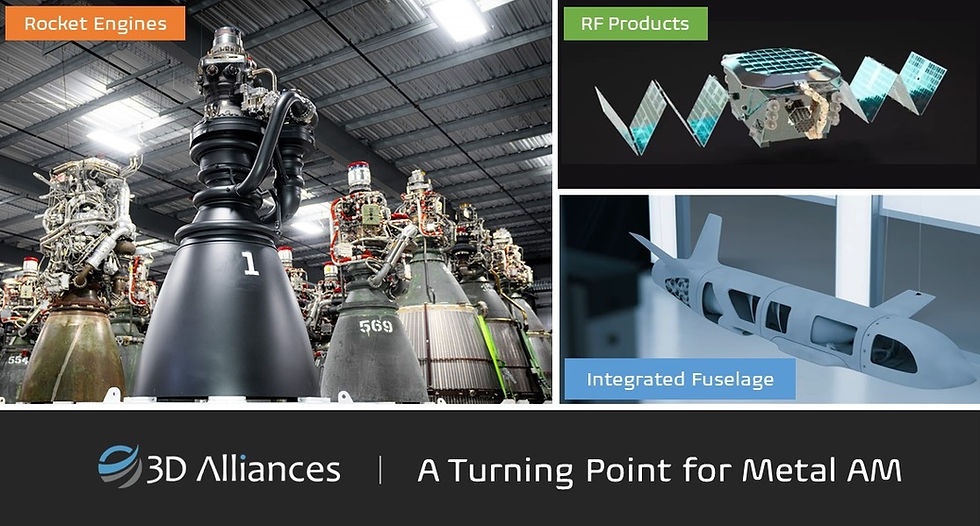
For more than two decades, metal additive manufacturing (AM) has promised to transform production. Yet for most of that time, its use remained constrained, focused on prototyping, tooling, or niche, low-volume parts. The prevailing model was simple: buy a metal 3D printer, install it in a workshop, and use it as a standalone production tool.
Today, a new generation of companies is rewriting that model entirely. Rather than treating metal AM as a machine-centric capability, they are embedding additive manufacturing into full-stack, software-defined production systems. Their approach is not just about printing parts, it is about redefining how products are designed, manufactured, and scaled.
Here are three companies that use metal AM as part of an integrated digital manufacturing architecture.
SWISSto12: Scaling AM for High-Performance Products
SWISSto12 is pioneering new frontiers with a revolutionary class of small, low-cost geostationary satellites. The company aims to connect the world by making high-speed connectivity more scalable, faster to deploy, and less costly to operate.
The company offers a unique perspective on how to industrialize AM for high-volume, mission-critical applications. It specializes in radiofrequency (RF) components and satellite payloads, where performance, weight, and reliability are paramount.

Powering next-generation Satellite Communications. Image source: Swissto12
From Components to Integrated Systems
Traditionally, RF systems consist of hundreds of individual parts assembled together. This creates high complexity, increased failure points, and longer production times. SWISSto12 uses Metal AM to redesign these systems as monolithic, integrated structures:
Multiple components are consolidated into single parts
Internal geometries are optimized for performance
Interconnects are minimized
The result is lighter, smaller, and more efficient products. Unlike many AM use cases, SWISSto12 has achieved true industrial deployment, with over 1,000 functional products deployed in space, zero reported failures, and qualification to aerospace standards.

Over 1,000 metal functional products deployed in space. Image source: Swissto12
SWISSto12 holds one of the largest IP portfolios for space RF products based on additive manufacturing. Its technology enables the design and manufacture of complex, high-performance, lightweight antennas, as well as RF filters and waveguides.
This demonstrates that additive manufacturing can move beyond prototyping into reliable, repeatable production.
Divergent Technologies: Reinventing the Factory
Divergent Technologies (Divergent 3D) is a California-based manufacturing technology company that is revolutionizing vehicle and aerospace production using AI-driven design optimization, metal AM, and automated robotic assembly.

3D printed Integrated fuselage . Image source: Divergent 3D
Conventional manufacturing relies on fixed tooling, molds, and assembly lines, creating rigidity, high upfront capital costs, long development cycles, and limited design flexibility. Instead of designing parts for manufacturability, Divergent designs entire structures optimized for performance, then uses AM to produce them.
The process is fundamentally different: components are digitally engineered as lightweight structures, Metal AM (LPBF) is used to print modular “nodes,” and robots assemble these nodes without custom tooling. Divergent eliminates traditional constraints:
No tooling required
Designs can be updated via software
Production scales digitally, not physically
The result is what many describe as a “software-defined factory.”

Next generation end-to-end digital manufacturing. Image source: Divergent 3D
SpaceX & Velo3D: Pushing the Limits of Physics and Manufacturing
From its early days, SpaceX embraced additive manufacturing for rocket engines. As its ambitions grew, particularly with the development of the Raptor engine, it encountered a fundamental barrier: many critical components could not be manufactured using conventional methods or legacy AM systems.

Raptor 3 engine by SpaceX. Image source: SpaceX
This is where Velo3D entered the picture. Rather than offering just another LPBF machine, Velo3D introduced a tightly integrated ecosystem combining:
Advanced simulation-driven print preparation
Real-time quality assurance
Process control at the laser toolpath level
This integration enabled SpaceX to produce complex engine components that were previously impossible to manufacture. Over time, SpaceX expanded its use of Velo3D systems, leveraging them for propulsion components and integrating the technology deeply into its production environment.
In this model, AM becomes a core enabler of product innovation, not just a manufacturing tool.

Three generations of Raptor 3 engine by SpaceX. Image source: SpaceX
A Turning Point of Metal Additive Manufacturing
Metal additive manufacturing is entering a new phase. These three cases demonstrate how deep integration of AM can unlock breakthroughs in performance-critical systems and redefine entire manufacturing architectures.
What sets these companies apart is not their use of Metal AM, it is how they use it. They do not simply print parts, they build digital manufacturing ecosystems. And in doing so, they are not just adopting additive manufacturing, they are reinventing manufacturing itself.


Comments